
What Is Aluminium Blister Foil Used For?
Aluminium Blister Foil sits between medicine and the outside world. It protects tablets and capsules from moisture, oxygen, light, and contamination. In practical terms, it is the bright metal layer peeled back beside a pharmacy counter, often only a few micrometres thick. Yet that thin barrier can influence shelf life, product stability, and patient confidence.
Demand is closely linked to pharmaceutical consumption. The IQVIA Institute’s Global Use of Medicines 2024 report forecasts worldwide medicine spending to approach 2.3 trillion US dollars by 2028. Meanwhile, Smithers identifies pharmaceutical packaging as a major growth area, supported by stricter quality expectations and expanding healthcare access. These figures do not prove that every product requires blister packaging. They show why reliable materials matter. Not every blister needs the same foil.
Guido Aufdemkamp, Executive Director of the European Aluminium Foil Association, has stated, “Aluminium foil is a permanent material that can be recycled again and again without losing its properties.” This principle supports aluminium’s long-term packaging value, although recycling depends on collection systems, coatings, inks, and local infrastructure. The material is not automatically sustainable. That point deserves more attention. In regulated pharmaceutical production, foil selection also involves pinhole control, coating adhesion, sealing performance, printability, and compatibility with the medicine. WHO good manufacturing practice guidance reinforces the need for controlled packaging materials and documented quality systems. Therefore, understanding What Is Aluminium Blister Foil Used For? requires more than discussing protection. It requires examining performance, manufacturing discipline, patient safety, and environmental trade-offs together.
What Is Aluminium Blister Foil?
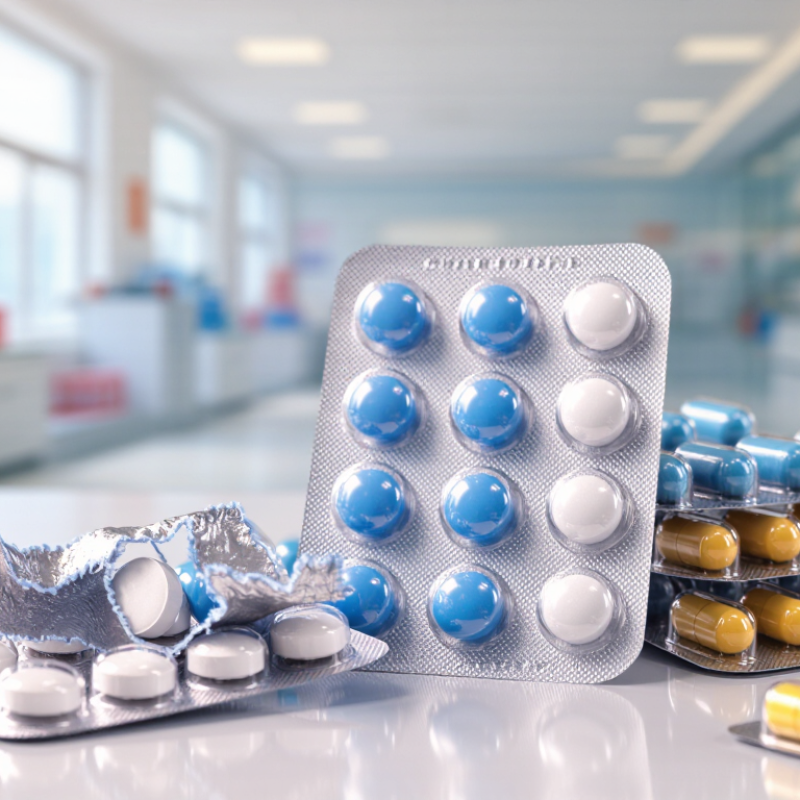
Aluminium blister foil is a thin aluminium-based material used mainly as the lidding layer in pharmaceutical blister packs. It usually combines aluminium foil, a heat-seal coating, printing ink, and protective lacquer. The foil closes each cavity after tablets or capsules are formed in plastic film. Patients press the pocket from the back, rupturing the foil and releasing one dose.
Its main value is protection. Aluminium blocks light, oxygen, moisture, and many external contaminants when the seal is correctly designed. Common pharmaceutical lidding foil is often about 20–25 micrometres thick, although the final structure depends on product sensitivity and machine settings. The European Aluminium Association identifies foil as a high-barrier packaging material, while the World Health Organization’s good manufacturing practice guidance requires packaging to protect medicines from contamination, deterioration, and damage. A 2024 Fortune Business Insights report valued the global pharmaceutical packaging market at over 100 billion US dollars, showing the scale behind these material choices.
A factory inspection focuses on pinholes, seal strength, coating coverage, and correct foil alignment. Small defects matter. A blister may look perfect but still allow moisture inside. Storage conditions matter too, especially in hot and humid regions. The material is not automatically suitable for every medicine. Compatibility testing, stability studies, and controlled sealing temperatures remain necessary. One limitation is clear: aluminium blister foil protects the product, but it cannot repair poor packaging design or careless handling.
What Is Aluminium Blister Foil Used For? - What Is Aluminium Blister Foil?
| Data Dimension | Typical Information | Why It Matters in Blister Packaging |
|---|---|---|
| Primary use | Lidding material for pharmaceutical tablets, capsules, lozenges, and other unit-dose products. | It seals the formed blister cavity and protects each dose until use. |
| Common package structure | Aluminium foil with a heat-seal coating on the product-facing side and printing lacquer or protective coating on the outer side. | The sealant bonds the foil to the blister base, while the outer coating supports printing and protects the foil. |
| Blister base materials used with it | Common bases include PVC, PVC coated with a moisture-barrier layer, polypropylene, and aluminium-based laminate structures. | The selected base determines forming performance, barrier level, sealing conditions, and the force needed to open the pack. |
| Typical foil thickness | Often approximately 20–30 micrometres for pharmaceutical lidding applications; the exact gauge depends on the package design. | Thickness affects puncture resistance, tear performance, barrier protection, sealing behavior, and material consumption. |
| Moisture protection | Aluminium foil provides a very high barrier against water vapour when it is continuous and free from pinholes. | This helps reduce moisture uptake, which can affect the stability, dissolution, or physical condition of sensitive products. |
| Light protection | The metal foil is opaque and blocks visible light and ultraviolet radiation. | It helps protect light-sensitive medicines and other contents from photo-induced degradation. |
| Oxygen and aroma barrier | Continuous aluminium foil offers an excellent barrier to oxygen and many volatile substances. | It can help maintain product quality and limit the transfer of oxygen or aromas through the package. |
| Opening method | The foil may be designed for push-through opening or peelable opening, depending on the product and user requirements. | The temper, thickness, coating, and seal strength must be balanced for reliable opening without accidental damage. |
| Printing and identification | The outer surface can carry product information such as dosage, batch details, expiry information, and usage instructions. | Printing supports product identification, traceability, compliance, and correct dose administration. |
| Mechanical protection | The foil helps protect the contents from contamination, handling, and environmental exposure, although it can be pierced by sharp objects. | Correct material selection and package handling are necessary to prevent pinholes, scratches, and seal damage. |
| Manufacturing process | The lidding foil is commonly printed, coated, slit, cut, and heat-sealed to the blister web during packaging. | Consistent coating weight, seal temperature, pressure, and dwell time help produce a secure and uniform pack. |
| Other applications | Similar foil structures are used for some medical-device packs, diagnostic products, confectionery items, and small portion packs. | These applications also benefit from aluminium’s opacity, barrier performance, lightweight construction, and formability. |
| Recyclability consideration | Clean aluminium is recyclable, but finished blister packs may contain bonded plastic, coatings, inks, and residual product. | Actual recycling depends on local collection systems and the ability to separate or process the complete package structure. |
Note: Actual foil thickness, coating type, seal strength, and opening performance should be selected according to the product’s stability requirements, blister-base material, packaging equipment, and applicable regulations.